So I have been what appears to be a retro crusade for the last 6 months or so. It all started with recovering a used Commodore Amiga 500 — and getting it to work again.
Since, I’ve researched and looked at a few games that I’ve played in my childhood – Monkey Island, Loom, Sim City – and Lemmings. I have been hooked on Lemmings for a few weeks now, but with limited time on my hands, I am not making the progress that I really wanted.

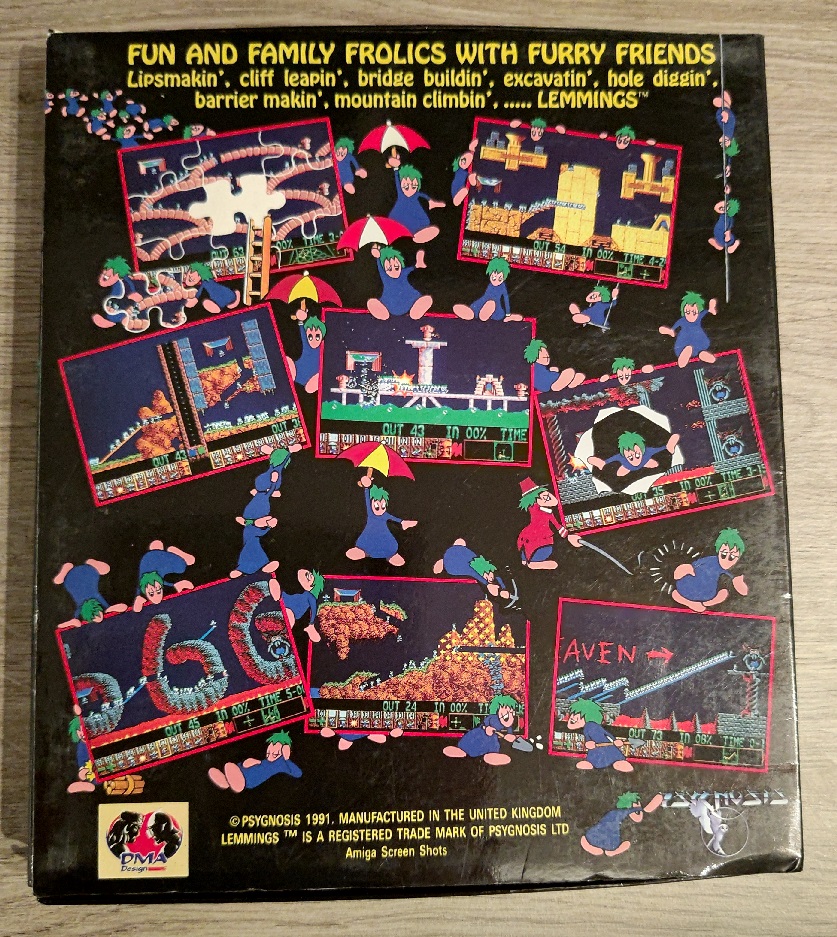
Lemmings is a puzzle game from 1991, that features dressed in blue, green-haired creatures that have nothing to do with the actual animal, the lemming. Actual lemmings also don’t have the tendency to throw themselves off a cliff – a long debunked myth (Lemmings Jumping Off Cliffs En Masse Is a Myth | HowStuffWorks). However, the pixel-lemmings from the game actually will throw themselves off cliffs – which pretty much explains the game’s concept: the game consists of levels, that present you with a layout – and you need to see your varying number of lemmings, level by level, from a starting point to the safe exit. There’s a handful of “skills”, your lemmings can adopt. By selecting the skills from the menu and assigning that to a lemming, you can turn them into a climber, a bridge builder, equip them with a parachute or make them a “stopper”, keeping the other lemmings at bay. You use your lemmings, equipped with skills, to overcome hurdles, puzzles and challenges, to eventually bring the required number of lemmings to their destination. There’s also a level of humor in the game: every time you feel you’re stuck in a level, can’t win any more or need to abort, you can make lemmings explode – individually or all at once – causing a funny explosion animation.
That’s a seemingly simple concept, but the game hasn’t gotten boring so far – 32 levels in. The first 15 levels or so were rather easy, progressively getting more difficult, focused on explaining the concepts. After, the more challenging puzzles began.
I think there’s four things the game combines in a fairly well-balanced manner, keeping it entertaining:
- Cleverly chosen skills for the lemmings
- Varying goals per level – the number of lemmings you need to bring in
- Time, timing and step progression
- Level art and design
Let’s dive into that a little bit:
The skills really drive your puzzle solving tactic. There’s 8 skills you can use with your lemmings, 7 if you exclude the “bombing” one – but to be fair, you can use it in a constructive fashion to solve a puzzle, if you’re short on a digger. Which skills you have, and how many of each, is defined by the level – so there’s great variance in how “flexible” you can be with your puzzle solving vs. how strict the game wants you to solve a puzzle a very specific way. Most levels would give you multiple skills and usually more than necessary, allowing you to solve puzzles in different ways. So you could go back and solve a level again, leveraging an entirely different strategy.
Also, 8 skills is a fairly well-balanced number of unique skills, that don’t overwhelm you in the beginning, nor cause too much overlap in the progression of the game, that would open up too many different nuanced combinations of skills that you have to keep track of. The skills lemmings can execute are distinct enough so that, while you can solve a puzzle through multiple ways, you don’t get confused about which skill to apply now, once you made your plan.

Varying goals per level help keeping it interesting: every level has its own number of overall lemmings you need to deal with and the percentage of lemmings that need to make it. While most levels were generously designed, there are levels that do not allow any mistakes, fallen down lemmings or a misplaced lemming that needed bombing. Other levels allow for a very specific amount of casualties. The number of lemmings can also be a challenge when you can’t really, say, contain and “park” most of them, while you work with a few lemmings to assign them skills, to build the path to the goal.
That’s a tactic I use quite frequently when solving levels: I would “park” the majority of my lemmings with one or two “stoppers”, only allowing a handful of lemmings through, to work with, and assign skills to, that slowly but surely build the path to the exit. That buys you time to work with focus. For some levels, that’s not possible, because you may not have stoppers or you need to bring 100% of your lemmings in. As soon as you turn a lemming into a stopper, you have to delete them at the end of the level, because stopper lemmings can’t be turned back into a normal, walking lemming. This causes an interesting challenge: you may need to work on multiple lemmings at the same time, assign them skills, track their progress, and re-assign them a new task, before they fall off a cliff. That causes a dynamic of hectic, at least with me, because you need to multi-task between different places on the screen, working on different things at the same time. For some levels, parking the crowd for too long isn’t an option either: since all levels have a time limit, you may have to release the lemmings from where you herded them, so they can make their way to the goal post, before the time runs up. Again, this may also cause hectic, as the time limit in some levels is designed to make it challenging for you to complete the puzzles “in peace”, or simply eradicating any room for failure that requires you to recover or work on a plan B. Time and timing in some levels may demand that you build a plan and rigorously execute on it, one step after another, without messing up – and you may need to adjust or fine-tune your plan by starting over a few times.
Last, the levels are designed beautifully and creatively. There’s no level that looks like another – at least not with the 32 I tried so far. The levels provide a lot of different challenges, such that you don’t just have to build a bridge to overcome an abyss, but sometimes have a few lemmings fall down equipped with a parachute and then have them build a small staircase so the rest can fall onto the staircase, making it a safe fall-distance. Or you have to climb up to the goal post. At times, the obstacles can only be dug through from one direction, but not the other – or you find materials you cannot dig through. There’s a great variance in how the levels are setup, such that seemingly, no combination of skills that worked in one level, can be applied to another without modification. Blocks, background, and dangers such as fire, toxic, green fluids mix it up as well.
These four game mechanic tricks, combined together, finely balanced, make you want to stick with the game and progress from level to level, even though with rising number of completed levels, there’s no new game dynamics coming into play here. The balance keeps you entertained, with increasing level of difficulty, that demands that you keep staying creative in the puzzle solving process.
On the balancing – I can only imagine how much time went into building the levels, creating some and later getting rid of them, because they turned out to be too complicated or easy.
It’s funny how I looked at the game now, and how I had it in memory when I first played it with a friend a few times when I was still in primary school. I remember drawing a few level designs on my own with my pencils on pieces of paper, trying to create challenging level ideas that would be hard to solve. So the game must have excited me from both angles: solving the puzzles, but also figuring out what good puzzles are comprised of, so they can’t be solved right-away.

If you enjoy game postmortems, here is the one for lemmings: Classic Game Postmortem: Lemmings
Yes, I know that there are a number of Lemmings games out there. I haven’t played them all and most likely do not want to – the game dynamics in some of them differ vastly from the original one. If for better or for worse, I can’t say. So far, I have only played the original Lemmings game on the Amiga 500 – and am looking for the “Oh no, more lemmings” successor for the Amiga 500.

 FRICKELSOFT