The more I play Lemmings, the more I realize that I tackle different levels quite methodically with the same set of steps, before I attempt in solving them.
Right at the beginning of the level, when the lemmings start to fall out of the ceiling trapdoor, I would use the “Pause” button to pause the game. I look at the mini map to figure out where I am and how large the level is, then try to find the goal post the lemmings need to go to. If it’s a large level, I need to mentally account for enough time on the clock to have all lemmings walk from start, to finish. For levels that stretch multiple screen widths, I need to mentally account for a minute just for “walking”, before the time runs up.

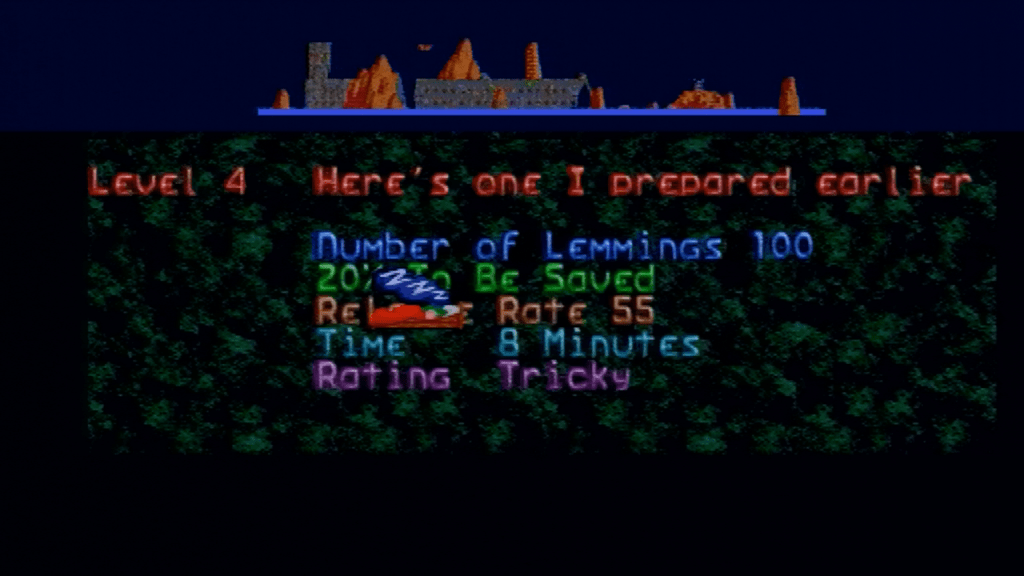
The clock is the second thing I’ll look at while pausing. The time constraint for the level is given away on the loading screen before the level even loads – as well as the mini map of the level. But only once you have looked at the level on full screen, browsed through the screen(s), looked at a few obstacles, only then you can judge how generous the time budget is.
Next, I’ll look at the skills that I have at my disposal. For many levels, it’s a short glance, if all 8 skills say “20” or “10”. For some levels, there are only specific skills available, also limited in amount. I’ll try to make a note of which ones I have available.

With the skills in mind, I’ll browse the level again, from start to finish, while the game is still paused. This time, I’ll look at every single section between where the lemmings come out and where they need to go, mapping what I think the lemmings need to do, with the skills at my disposal. I am also making a mental note of how many bricklayers I may need to overcome an abyss or to climb up a flight or two – and where I think I need to start activating them, so the incline works out.
That way, I am going section by section of the level, keeping track of how many lemmings I need, for what actions. If I need multiple lemmings, because along the way, I need one or more stoppers to prevent them from falling, while at the same time, sone other lemmings build things, I need to account for that as well.
With the rough estimate of lemmings for building the “pathway” to the goal, I’m trying to apply my usual tactic: I’ll let the required amount of builders walk, and after, I’ll use stoppers to contain the rest of the lemmings from where they emerge. That way, I can keep them safe, while I am using the designated path builders to build the way. Once that way is established, I’d bomb the stopper(s), setting the rest of the lemmings free. For that tactic to work, I need a rough estimate on how many workers, while I keep the rest waiting. This is also why knowing my time limit, how many lemmings I have, and how many the level requires me to rescue, become important. If I need to rescue all of them, I can’t use stoppers that in the end will have to be bombed.
With all that prepared, I’ll unpause the game. I’ll try to see if I can dial down the speed at which the lemmings emerge. That gives me some extra time to let the first ones through and place my stopper(s) – and I can later dial up the speed of lemmings again.
And then – I try and master the level as good as possible – hoping that nothing upsets my strategy, such as squashing columns that you couldn’t see before that only emerge when lemmings approach. That works most of the time for most levels, except for those levels that don’t allow stoppers. These force you to immediately after the beginning of the level, multi-task. For these, I usually try to develop a strategy with trial and error.

 FRICKELSOFT