If you remember the fun of late 80s and early 90s point-and-click adventure games, you may remember that the internet wasn’t a thing back then. When you ran into a puzzle that you couldn’t solve right away, you had to try things out. Or power down and come back later … when you thought hard about it and came up with a few new things to try. Or you spoke to your friends on the school yard and they had played the game before and told you what to do. In case you had some pocket money and it was a new game you played, you may have been able to purchase a magazine that gave you a few hints and tipps and tricks. As a very last resort, there was a hint hotline you could call – a fairly expensive hotline – and your parents wouldn’t be too happy about the phone bill.
Today’s games don’t suffer from that problem. You could still ask your friends and buy magazines that could give you hints – there’s also a fairly well-established market on game guides and complete solutions. What dramatically changed, is ubiquitous access to the internet, where game guides and walkthroughs are posted for free, and are accessible within seconds. Sure, I get that if you’re not used to adventure games that you may need the occasional hint to progress – but complete walkthroughs pose the danger of sticking to “just reading it all through”, spoiling some of the fun for you – or reading sections that describe stages in the game you haven’t been to yet.
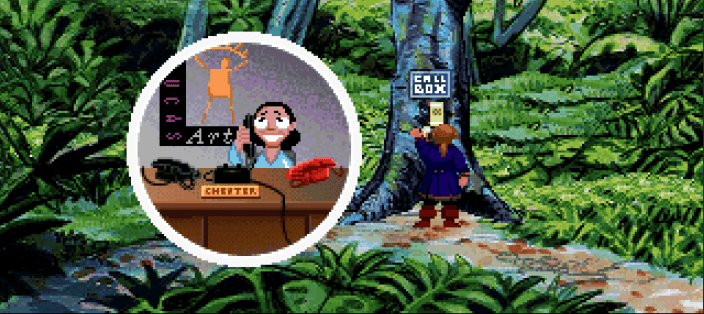
It was surprising for me that Terrible Toybox built a hint system into Thimbleweed Park, delivered as an update to the game, post-release. Ron Gilbert explained it on the game’s blog. Adding it via an update, he still seemed dissatisfied that they had to do it – seemingly struggling with today’s players that requested it.
Gilbert mentioned two reasons why adding a hint system in Thimbleweed Park was necessary:
- Modern players don’t want/need hints
- Players that previously played adventures don’t have the time/won’t make the time to play as long as the game would take
This is an interesting problem to solve, because you need to know and understand your audience, while at the same time strike a fine balance between providing help and guidance, and have a continuous user experience, while at the same time not steal rewards from the player by making stuff too easy.
I am not sure if (b) is really a reason to implement a hint system and that should be a deciding driver. The grown-up, experienced adventure players would take the game away at some point and pick it up later – especially if they have a relationship with the franchise or the genre. Looking at (b) solely, I think they’ll not necessarily need an elaborate hint system. If you plan for a hint system anyways, fantastic – but I am not sure if you’d plan one specifically for this audience. I suppose most would not want to spoil their gaming fun taking the easy route and looking everything up on the internet – especially since some may have made the mistake (too easily) in the past, and regret it. For them, the hint system would give them a way of making progress, without spoiling too much – or creating the habit of “I’m stuck, let me look it up”.
For (a), that appears to be an unfortunate trend, where players are looking for the casual continuous game experience, and they won’t deal with friction of puzzles that take some time to figure out – or require to go to different places. This may have to do with the shorter attention span that some of us are used to consuming social media and the like today.
Also, playing on smart phones may also influence the player’s behavior and what they expect from a game on a very mobile platform. You’d pull out the smart phone for a few minutes while waiting for the bus, play a few minutes expecting to progress, and put it away. On top, there may be notifications from Twitter, Instagram, Facebook, Tiktok and everything else coming in that distract your thought process from puzzle solving to engage with others. You may never get to the point of thinking hard about a problem or diving into the world that the game creates for you – and then there’s the need for a hint system.
It’s an interesting balance that’s required – especially if you are trying to attract a broader player community, beyond the hardcore adventure enthusiasts. The two methods used in Thimbleweed Park, and what I hear also in Return to Monkey Island, make a lot of sense to me: you introduce two game modes, “Easy” and “Normal” whereby “Easy” is targeted at less experienced adventure gamers or less experienced gamers in general. The “Easy” mode would have a few less puzzles, or easier to solve puzzles, so that progress can be made easier – and you get to learn how absurd some of the puzzles could be. “Normal” would be the puzzles that are challenging, for players that enjoy being stuck for a few hours or even days, that feel rewarded by overcoming a challenge, less by the fact they’re making process. For both modes, the hint system should be available, such that very stuck players have a chance to overcome a hurdle, before they get discouraged.
The system in Thimbleweed Park is delivered through the telephones in the game – in the mansion, as well as the city. You would call a number that you found on a placard. Using one of the phones, you call a number to engage with the system – and get hints about where to go next.
That’s quite elegant. Gilbert mentioned that they had envisioned adding friction such that you’d have to find or get money, so you could call the number. That would prevent the player from casually walk up to the phone, dial the number, and get the hints. You’d first have to overcome the friction, requiring you to think about it, and engage with the game. Unfortunately, as described in the blog again, requiring money for the phones would have broken other puzzles or complicated them. So – the hint system via phone was introduced without friction.

If you get to design the hint system as part of the development process, rather than having to post-release add it, that opens a few more possibilities. In classic, funny point-and-click manner, the system could have its own humor as well as desired friction and fit into the game neatly.
I could imagine a system whereby you’d collect or something, like the specks of dust in Thimbleweed Park, and redeem them later with the hint system, like the dust fairy you meet at night in a specific place. Collecting the specks of dust may take some time and dedication, and there’s not an unlimited amount of them available, creating a friction for the player.
You could also let the player get a fishing rod once, and have them fish for red herrings in the sea. These red herrings would then be carried to a troll, that, when fed, will give you your hint. The friction could be introduced by letting the character wait increasing amounts of time before the next red herring bites – such as 5 seconds in the beginning, then doubling the wait time every time the user fishes next – 10 seconds the second time, 20 seconds the third time, doubling until the maximum wait time of, say 10 minutes after 8 hints. You could also make the fish go bad, if it sits in the inventory for too long, after being fished, such that the player doesn’t fish them in a convenient time and holds on to them for too long.
As you build the hint system into the game as part of the original design, you would also want to make sure that it fits into the story and the whole experience, including the story you want to tell. It shouldn’t feel like an alien concept, either by art, nor by story and game design.
I wonder if I’d want to honor and reward the players who did not use the hint system in their first-time play-through; or used it a maximum of one time, if they were curious if and how it works. That would be an additional motivation for players, to keep their discipline and play the game the way it was designed: as a puzzle game you spend time with, get immersed in the world that was created, interact with the characters and get the hints and ideas for solving puzzles from there. The reward could be an alternate ending that could be played – or an additional cut scene. You’d need to prevent a user from Save & Load cheating their way around recognizing if a hint was used or not. This all could be implemented in a system such as Steam, where you could potentially check for first-time play-through and issue a badge for being a “No hints hero”. If people cheated through online walkthroughs, well – they need to live with their conscious then.
I am playing Return to Monkey Island as we speak. I’ll most likely have an update for this post in a few weeks, when I explored the hint system there.

 FRICKELSOFT
One thought on “Hint systems in point-n-click adventures”