I have thought about what a hint system could look like for “Return to Monkey Island”, and brainstormed about a few ideas for designs here.
Now that I have played Return to Monkey Island a bit, trying the new hint system, I think I have a few more opinions. If you’re interested, read on, there won’t be any spoilers for the game.
The new Monkey Island’s hint system, that would give you a hint or two if you’re stuck on a puzzle, has a fairly clever design. As part of your inventory, you can access the “hint book” at all times. The hint book is contextual, so it knows in which part of the game you’re currently at, suggesting very accurately, where it may help you. It’s not giving away the solutions right away, though. The hint system would give you multi-layered hints: it gives you some information and if that doesn’t help you, you can ask for more, and the system would continue to give you increasingly direct hints until it gives you the solution after 4 or 5 rounds. First, after you selected the part of the game you struggle with, it will first give you reminders about what the puzzle at hand is about – things you make have heard or subtly been nudged about in previous dialog or surroundings.
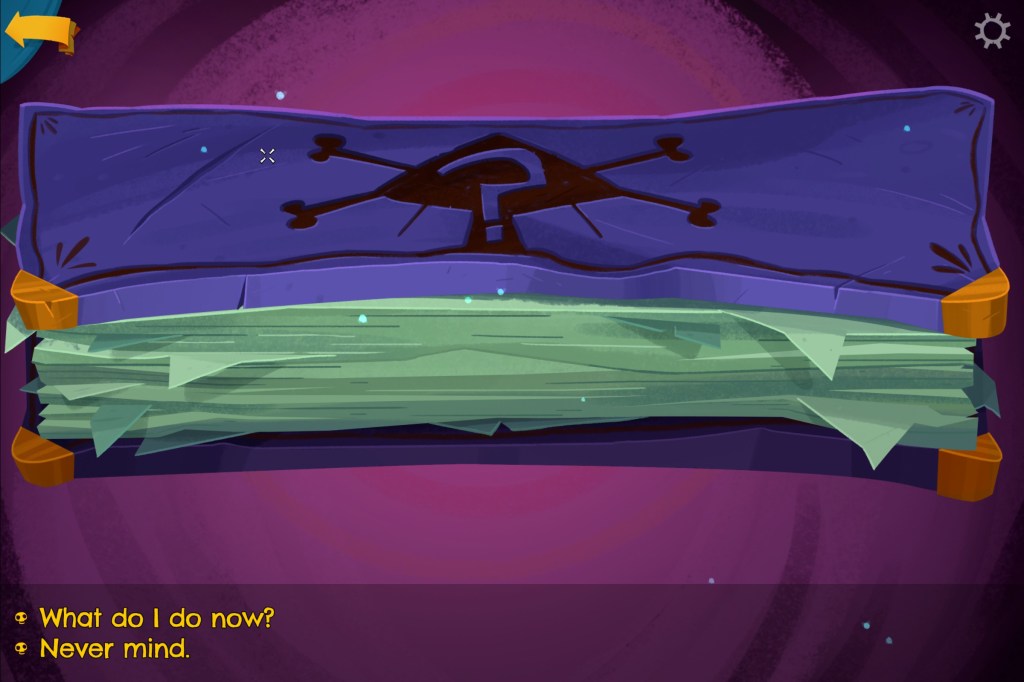
After, it will start injecting ideas into your head – not direct solutions, but what to think about such that you *could* guess it on your own – or re-focus your thinking into the general direction. After, it would get more concrete on where to look or who to talk to – and eventually, give you the solution.
It’s quite elegant in that it doesn’t give away the solutions immediately. It will give you 3-4 chances to solve the puzzle on your own, with increasing levels of clarity about how to approach the puzzle. As the player, you don’t have to immediately get the solution, but use the hint system to guide you into the general direction of how to solve the problem. Sometimes, all you need is being corrected or redirected to the right path of thinking, and then you solve it on your own.
That’s perfect, because that makes it easier for a player to decide, if they want to use the system – and how far they want to use it. It’s not about getting the solution, there’s new shades of grey in between “no hints” and “getting the answer to the puzzle” – making it more approachable and accessible, even for seasoned players. For new starters, by revealing progressively and not right-away, they get to observe and learn how puzzles in adventures work – and what the tone of puzzles in the game is. That also has a learning effect for players, if they want to use the hint system as such, that could work out nicely especially in early stages of the game, and if you’re new to the genre.
Quite elegant all in all – which leads me to re-think the hint system discussed in an *earlier post*. I still think I’d want to have a system that asks players to pause and think, such that they can’t ask the system 4 times, and get the solution – but they have to work for the hints, making them a semi-expensive good. I see however the power of a progressive hint system, such that the first 2 or so hints to a puzzle should be free, and only if you need to have the more direct description of what to do, you “pay” the system by collecting specks of dust, or fish to feed the wise hint troll.
A flaw in my earlier thoughts about the system is that it should be accessible from anywhere. Something that the hint book solves easily, because it is part of the inventory. Had the system been the wise troll, the hint-granting tree or something that needs to be visited, it would not work for all parts of the game, especially if the character is trapped somewhere or on a boat and can’t travel to the hint system destination.
It’s an even greater balancing act than anticipated. Not only do you balance between how much you give away and how much you “just” hint, you also need to balance friction for players carefully with accessibility of hints to avoid frustration.

 FRICKELSOFT