When you are designing a piece of software, service or functionality, sometimes, you need to take the user on a journey with you. Especially in a new experience that users haven’t engaged in before, or you need the user to complete certain steps as a means to an end, you need to keep them motivated and engaged.
For software and configuration, that means you explain the steps ahead and break the journey down into digestible smaller chunks. You also try to encourage the user to stick along and lay down what’s in for them.
For games, that’s a little different. Usually there’s a setup or a story that you lay out to the player, a context or a problem space that you embark on. If you consider a game like Loom, you’ll notice that there’s a introductory story that you, playing Bobbin, are pulled into, a starting sequence that makes you watch the Elders in a heated debate with Hetchel. The Elders punish Hetchel, turning her into an egg, when they’re interrupted by an attack on the loom and turned into swans themselves. There’s even an audio drama that you should listen to before you start the game – it gives you even more context and clues about the game’s unique controls and UX.
While that’s how you’d expect a game to behave, if you look at The Secret of Monkey Island, you’ll notice there’s very little context you get. The first scene is literally Guybrush showing up at the lookout, opening with “Hi! My name’s Guybrush Threepwood, and I want to be a pirate!” – and that is setting off the adventure. There’s no context setting and no backstory about Guybrush, what drives him to become a pirate or how he ended up on Melee Island.
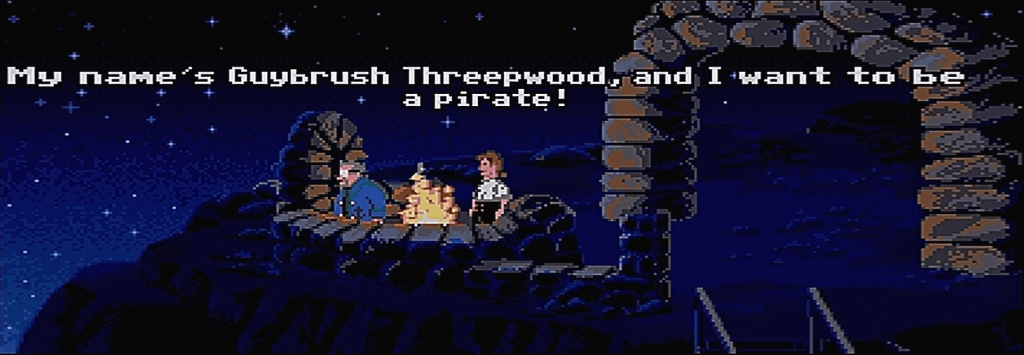
What’s curious about this opening is that the playable character is introduced with a motivation, but without further context, so you don’t exactly know what and how the progression of the game will be – or where you’ll end up. It also becomes clear that the main character doesn’t have a clue what’s going on and needs to ask around as to how to become a pirate – and from then on, you start the journey. The setting in itself is motivating the player, because not too much is given away, in general, there’s not much knowledge about how one does become a pirate, and so joining the main character in becoming one and figuring out how what works, is an interesting incentive to start and continue playing.
The setup has a number of interesting effects:
It immediately conveys the understanding that the playable character is no super hero, fully sharpened specialist in what they are doing, bringing down some of the pressure of succeeding immediately. Nothing is more frustrating than being thrown into a setup and struggling with the keys or gamepad or controls, while being in the context of the superhero of the story with a big backstory. The character is a beginner in what they’re doing and is taking the player with them in figuring out the next steps. Mistakes and mess-ups along the way are to be expected.
That drives a lot of sympathy for the character – immediately from the get-to, but also through the first conversations that emerge as part of figuring things out. It’s almost like you are a lot more patient with yourself and the character, trying things out and exploring your environment: exactly what you want in a graphical adventure.
Starting in the same knowledge-level as the main character also helps with bonding with the character – you want to make them win and achieve their goals and every right step along the way makes it feel like it’s a joint success and a joint accomplishment. Over time, you grow together as you tackle problems, challenges and make progress towards the goal you set out to achieve.
I see a few parallels with another game that I have played and enjoyed a lot: Nintendo’s The Legend of Zelda: Breath of the wild”. You start out almost naked without a slightest glimpse of what’s going on – and the story is not unfolding until after a few hours of gameplay. And you learn together with the protagonist, Link, how to navigate this unknown world, and pick up material to fight. You may not know the full story unless you go and complete all side quests to gain back memories from the past. You could theoretically complete the game without that knowledge or without learning about the story – but at least I was drawn into learning more. Every enemy is overpowered at first, and you most likely run away from all of them in the beginning, until you have more stamina and hearts, to fight them and stand a chance (at least I did, playing Master Mode 🙂 )
One of the lessons that I’ll take away for me is – take the user, player, gamer with you on a journey, and meet them where they are.

 FRICKELSOFT