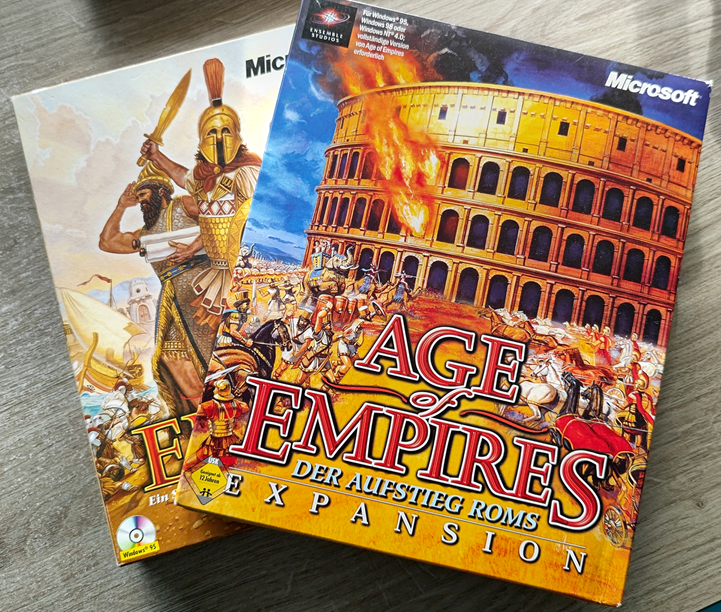
Now that Age of Empires is more than 25 years old, I thought it was about time to play it once more. After I had played the original game for a while, and after, Age of Empires II and III, I had last played the “Definitive Edition” a few years ago.
One of the things I noticed, having forgotten some of the original version, playing the Definitive Edition, going back to the original version on a laptop with Windows 98 SE on it, is how much they patched and changed the mechanics and gameplay for the DE.
The original version got changed by the expansion pack “The Rise of Rome”, then again through the Definitive Edition, and later through a few unofficial patches that the community created. It’s fantastic how nostalgia lies to you – or my playing of Age of Empires II and some of the improvements diluted my memory.
There’s so much stuff “missing” in Age of Empires, if you have diluted memories or have played the definitive editions.
Let’s look at a few of them:
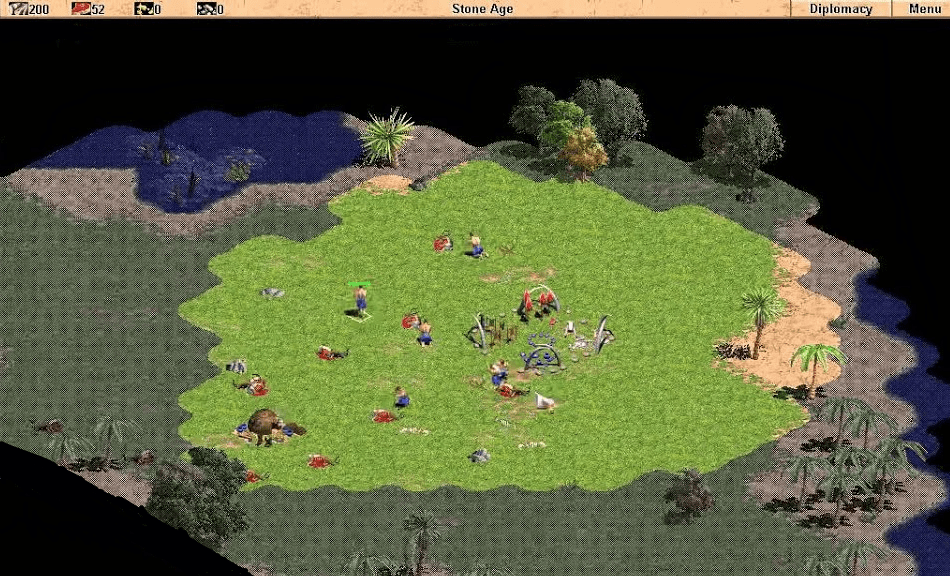
- Production Queues are missing. If you’re building a unit, the “building” that produces that unit is busy. You can’t click multiple times to signal “build me 5 of these”. No – you wait until the unit is finished, click again and start the next.
- Must select the building to create units. There’s no general overview of all units you can produce that allows fast building of units. You select the building that “trains” the unit and select it there. That also means that, no matter where on the map you are, you always return to the town, select the barrack, and only then create a new unit.
- Cannot jump back to town center: there’s no keyboard shortcut. You scroll back on the map, or click into the mini map.
- Finding/going through idle villagers: there’s no such thing. If a villager Is idle, you need to see them or find them. You don’t find out automatically.
- When a new unit is finished, it spawns on one of the edges of the building they’re created on. You can’t defien that a newly built unit must walk over to a checkpoint or a grouping spot on the map.
- No ways of automatically renew a farm: if it’s exhausted, you select the villager and tell them to build a new farm.
You could argue that some of these “omissions” aren’t simply oversights or lack of design by the development team, but actual design choices, to give the game a very specific spin – and force the player into specific habits, and force them to make harder decisions. Take the missing shortcut to get back to the town center. When you’re in the middle of a war, directing and commanding units to fight the enemy, you still may want to rebuild new units or rebuild some of these farms that were exhausted – so why can’t I build new units from a menu that’s always on display or rebuild all farms automatically? And why can’t I press a button that takes me back to the town center? You could argue that it’s a design choice – to make you focus on where you are, make it costly to move away from where, similar to how unfocused war would be – and that you need to make the conscious choice of either managing war vs. supply and infrastructure. It’s a game mechanic to forces you to choose between micro management of war actions and managing your economy.
This becomes especially relevant for multiplayer sessions, which Age of Empires was also designed for. Before you engage in war, you need to make sure your economy is in order and won’t fall apart, for yet another player to overrun you right after. It’s a game mechanic, changing the way war, preparation for war, and post-war activities are handled by the player.
Also – Age of Empires was released in 1997, a defining era for real-time strategy games. You would assume that there was some form of experimentation, trying something new, and looking for that competitive edge to build some of the game mechanics differently. So some of these design choices may have existed to ensure that the game felt differently than what was there before.
Some of these things on my list above were patched through Age of Empire’s expansion pack, “The Rise of Rome” (or changed later in Age of Empires II) – arguably due to strong player feedback, and pressure of other real-time strategy series in the same time frame (e.g. Command & Conquer, StarCraft) that offered these “convenience” features.
I was surprised about a number of things that worked very well:
- Grouping of units and assigning them a shortkey, and activating them quickly worked well.
- The first campaign with Egypt that serves as a fantastic tutorial – I really liked how the campaign was setup, walking the player through most of gameplay, allowing for a smooth learning curve.
- I liked that the technology tree was well defined and dependency chains of which building is required to build another building or units was well-established. The original game came with a printed, laminated technology tree leaflet
- Networking support was builtin – with the focus on multiplayer experience, that made a lot of sense.
So a lot of learnings for me, re-playing AOE again:
(1) I realized I didn’t remember all things well, and simply forgot how they were.
(2) Some things I remembered differently, possibly due to patches or changes from later versions, upgraded versions, later patches – or simply playing other games that worked differently.
(3) The game was created in a defining era of time for real-time strategy – some “deficiencies” may be design choices, and not omissions or lack of time of completion.

 FRICKELSOFT