Underrated game mechanic: savegames. There: I said it. It’s one of these things in game design that, if you’re doing it right, no one knows it’s there, if you’re doing it wrong, it gets in everybody’s face and it’s the thing that ruins your game play experience. They’re done right, if they’re not intrusive. In a best case scenario, if you find a good metaphor for that embeds your savegame mechanic into your game, it may even support the game story, and at least make it so that saving your game doesn’t break immersion (too much).
I am sure you’ve had one of these experiences where the savegame mechanic ruins your gameplay. Either saving/loading didn’t work the way you expected, because you can’t save all the time and it’s restricted or there’s only autosave in the worst locations — or you had this nightmarish experience of corrupted savegame files.
There’s no way around it – when designing a game, you have to get saving and loading right. Right, making it fit for your kind of game. Not all savegame mechanics work for all kinds of games, which is why it can be annoying af. But a password save system like in Lemmings won’t work for a game like The Legend of Zelda: Breath of the Wild. Understanding the game you are creating and the immersion that you want players to have, is critical.
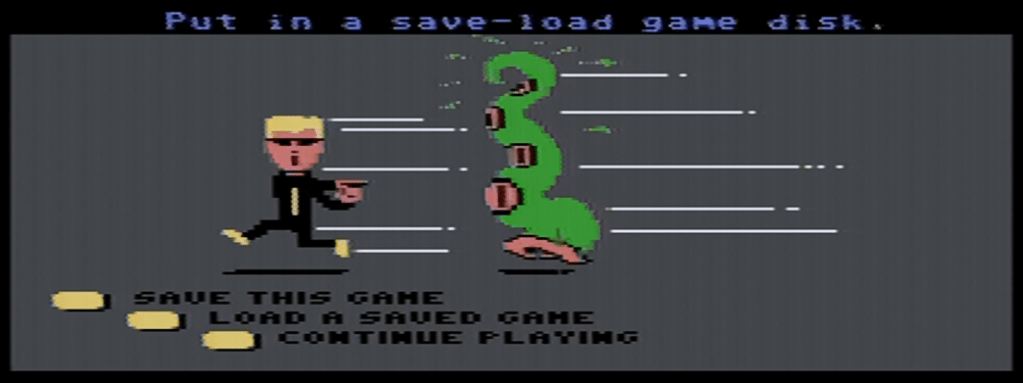
There’s a few different savegame mechanisms that I have seen:
- Manual save points: You let players save their progress at specific locations in the game, such as specific rooms. One of the Resident Evil games uses this mechanic through typewriters. When you see a typewriter – and you have a color tape with you – you can save. This is restricting when and how often someone can save their game.
- Password Save: You provide players with a password or code when they save. This could happen after a certain milestone is reached, or the level is finished. I know this best from playing Lemmings on the Amiga – but it’s common in early console games, too. Mostly useful with linear gameplay with pre-determined checkpoints.
- Save Anywhere: Your players can save anywhere and anytime they want, and it’s okay. It’s irrespective of where they are in the game. It’s probably the best idea to support this for open-world or non-linear games. This is giving the player the most flexibility, as they can commit their progress whenever they make progress. There’s some tradeoff to be made in order to make the game not too easy or too fast to complete. Some restrictions could be applied, e.g. restricting saving in dungeons or special locations.
- Autosave: You provide an automatic way of saving progress in the game, without having the player to do it manually. I haven’t seen this implemented very well anywhere, mostly in combination with a manual save points function or a n “save anywhere” function.
- Superman Mode/Master Mode: You provide players with a single or a very limited number of save slots, so they are likely to overwrite previous saves, making the decision “do I save now?” hard to answer. You could also implement it such that only one save per x amount of time is allowed. Hard to balance – because it increases the difficulty level, of players can’t go and load ealier savegames frequently. There’s also the angle of frustrating users, if they lose too much progress due to a mistake. I’ve seen, loved and hated this with Zelda multiple times.
- No save game at all: Do not give players a chance to save. When they make a mistake, you either respawn them in a near convenient point (with would be a graceful way of dealing with it) or implement it as “perma death” – they need to start over from the very start. Make your game an experience that requires commitment, learning by doing. This will ensure your players plan their moves carefully – but also very frustrating when they need to start over – increasingly so with much progress.
There are probably more – but with these at your disposal, what are you designing for?
Clearly, there’s the angle of making it easy for the user to save and store their progress away. If you make it too difficult or bring too many hurdles in the way, people won’t use the save capability. If they strategically need to plan for it – that may inhibit gameplay, if the game – otherwise – isn’t of the strategic or challenging nature. For as long as long as the gameplay supports the right savegame mechanic, it should be fairly easy to “just save” when users can – both technically, as well as understanding what the requirements for being able to save are. If players need to collect artifacts and then bring them to a typewriter in order to save – and the typewriter isn’t enough on its own – players need to know about it. And they should be able to find and save artifacts regularly, to be able to save reasonably often.
All of this needs to be balanced well. Well, relative to the difficulty you want the game to have for your game. Saving more often has the potential of making the game easier, because players can go back to recent progress easier and faster. Too many restrictions for saving, might make the game more difficult, but also less flexible to put aside whenever a player wants. The right level of difficulty for the game is highly supported by the savegame mechanic. If the game supports multiple difficulty levels, saving the game could follow these difficulties.
The design must also cater for the right balance for a player’s risk of losing progress when not being able to save, and the reward of saving often – relative to the game experience that you are looking for. They are running the risk of losing progress, specific items they collected, or saving in a state that’s too late, ending up in a “poisoned” save slot. The relative rewards may be that players can load a previous game and continue easily, trying different paths or alternatives, experience different angles of the game. The challenge herein lies in making sure a player is encouraged to progress in the game, and take calculated risks and enjoy the game in the right amount, without having to think about or fear save-overkill. In a best-case scenario, saving is used in the right amount as a strategic element. Looking at resident evil: the risk angle here, is that the player is facing more and more challenging enemies throughout the progression of the game, while at the same time, the color tape for the typewriter that is required for saving is very limited. The reward is that all bigger achievements can be saved and kept going forward, when facing the more challenging enemies.
There’s also the angle of providing players with more choice – and allowing players to make strategic choices about when to save, if it’s a mechanic, but also incorporating the savegame mechanic into difficulty levels, adjusting how and when games can be saved.
In all cases – the mechanic should not break the immersion a player has with the game. If the savegame mechanic isn’t too obvious for the player, and merges as much as possible with the game, its story and the overall nagivation in the game, that’s the best possible outcome. If you find that you’re breaking immersion with a too artificial way of saving progress that does not fit the gameplay,

 FRICKELSOFT
One thought on “Savegames as a game mechanic”