Railroad Tycoon is trying to stretch two interesting concepts together that you can’t really marry together, because they work on two scales, magnitudes, if you will.
In Sid Meier’s Railroad Tycoon, you’re trying to grow your railroad business, connecting cities, fuel economies in cities and regions and you’re trying to be faster than your competition, who also do the same. Growth is important, as there’s also an open stock market component there, where, if your competition grows significantly faster than you, your competition buys your company and your game is over. On your trains and growing track network connecting cities, you transport people, letters and notes, as well as goods (such as coal).
You are starting out in the 1800s, with steam engine, and a lot of smaller cities that grow as your impact on these cities grows. If they need specific goods that you deliver to them via train, they grow over time. Not connected cities do not grow. So in order to succeed, connecting cities and delivering goods is key. Throughout the game progression, time passes – and new engines are invented – such as Diesel engines that can replace your steam based trains. More modern trains will follow after that later. There’s a mix of micro-management as well as historic touches of history.
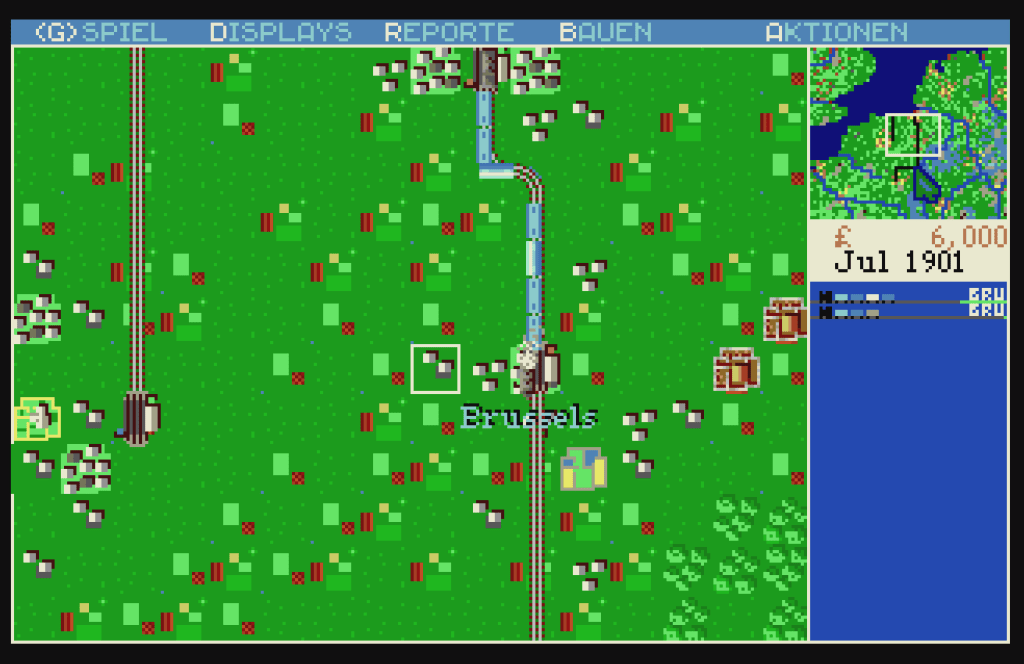
What’s interesting here, is that the game is marrying two times scales together: you’re micro-managing your trains, tracks, commercial setup to set yourself up for success, but at the same time, the game has this notion of traveling through time with you, through years, decades, up to the first century, until when the game is finished.
You see the current month and year displayed in the game UI, and the game is progressing such that it can offer you the experience of influencing cities and regions with your trains – so it moves fairly fast through months and year. However, at the same time, you see your trains travel on tracks, with the wagons connected, showing how people and goods travel on your service. For larger connections between cities, as one train is traveling from city A to city B, a train could easily be traveling for several months, somewhat clashing the time scales. Even in the good old times, when steam engines ruled the travel experiences cross-country, you weren’t on the road for months – that would have been a terrible traveling experience 😊 Clearly the visuals for the train and the actual time progression as run by the game aren’t lining up.

It is one of the harder puzzles that, when building a simulation, you have to conquer: getting the time scales correctly while not sacrificing too much of the immersion or the experience you want to show. It’s a balancing act, and also balancing importance of which experience you want in the foreground: is it that they should be traveling through time reasonably and experience the progression of train evolution, cities growing, flourishing – or is it that the trains travel in (more) correct speed between the cities – making sure your immersion and the graphical appeal of your fine trains moving for you in realistic time scales.

 FRICKELSOFT