If we are looking at games and how they implement the savegame mechanic to support their immersion and their creation of the game world, we need to talk about the first part in the Zelda series that was released on the NES console.
In 1986, the first Zelda game was released on the then Famicom system that in the western world was called NES a little later. The game was supposed to be supporting Nintendo’s new Famicom Disk Station which instead of leveraging classical cartridges, the console should then support smaller disks. A little bit unbelievable in this time, but back then disks were able to hold more data than cartridges could at the time. The system didn’t use the floppy disks we know today from the PC or home computers, but magnetic disks in plastic enclosures that were smaller than “traditional” floppies – called “disk cards”. They’d hold 128 Kilobytes of data. Interestingly enough, Zelda took more disk space than that, which required that the development team applied tricks to optimize disk usage.
Nintendo wanted to a AAA-title to introduce the disk system, which made Zelda a perfect game for that. Later use the game’s potential and release it on the disc station primarily and on cartridges in a secondary fashion. This disk system allowed for re-writing disks, which allowed saving back on the disk for the first time. Nintendo also had a service going where they’d write a game of your choice to a disk you own, which was cheaper than buying a new cartridge every time you wanted to play a new game.
So the driver for Nintendo was to leverage the disk system and also showcase the writing-back to the disk for saving the game. This wasn’t established for cartridges just yet, as (a) RAM was expensive and (b) the RAM needed additional hardware and power management (i.e. a battery) to keep the RAM on current, so that the saved progress wasn’t lost when the console powers down. Back then it wasn’t common to have cartridges that have a VRAM or a RAM attached, so saving progress to the disk wasn’t possible. By then a number of different saveame mechanics were implemented, some leveraged at the password system, other games didn’t have a saving option at all leveraging and supported more of an arcade style gameplay where when you progress until you die or stop, and your points, credits or slain enemies were recorded into an top scorer list.
Now that Zelda was designed to save progress on the disk – and proved to be a hit, Nintendo wanted to bring it to other markets. My guess is that back then, there wasn’t a very well established plan to bring the disk system to other regions than Japan, which is why Zelda was adjusted for cartridge distribution as well – which resulted in designing cartridges that could hold a ~128Kbytes large game like Zelda and resulted in designing a cartridge that had RAM for savegames. Since Zelda was a success in Japan, putting it on cartridge for other regions made sense – and you could decouple it from the disk station dependency.

The gold-coloured cartridge that was released in 1987 supported saving through a battery-backed SRAM module.

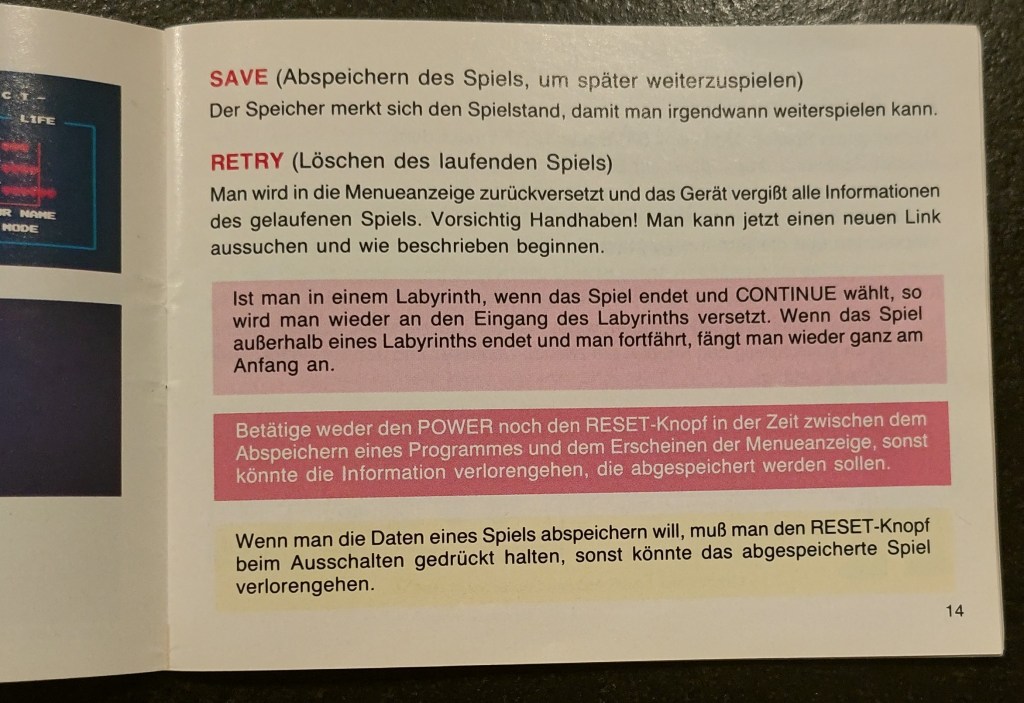
Not the way that a player with today’s game experience would expect it, but still provided a sensible saving option. Saving itself isn’t exposed in the normal menu or in the options that you see immediately in the main or the inventory screen. But saving is offered as soon as Link dies and as soon as he needs to recover.
There’s three options then that the screen gives you. One is continue, whereby you start at the place where Link died. In the case of dungeons you are transported, like today, to the entrance of the dungeon. Then there is a save option for you to save your progress to the cartridge. The last option is “Retry”, which ends the current game without saving, bringing you back to the main screen where you can start an entirely new run of Zelda.
But what if you want to stop the game in the middle of a run because you ran out of time, your mom cooked dinner, or a friend came over, or your father threw you out because the weather was too nice. How would you save then without losing your progress and without killing Link purposefully. Somewhat not very well known, but written down in the manual of the game is an option to save the game anytime you want, without dying that involves the second controller. If you put down the main controller and pick up the second controller, press select and then one of the arrow buttons on the left to choose direction, you are given the menu. It’s the same menu that allows you to save your game when Link dies. Through that not very well known combination of buttons on the secondary controller, you could save any time you wanted without dying too.

Zelda was the first game on the Famicom and in the Western world that supported saving progress on the cartridge. Despite the fact that it was somewhat clunky to use and clearly at the time there wasn’t a well-established mechanism of this is how you’re supposed to save, the option and the process of saving is available to end users and forefront in key situations, as in when Link dies.

 FRICKELSOFT