
Zelda: A link to the past is one of my favorite games of all time. I feel in love with it in 1993, when we had an SNES and I was able to borrow the game from a friend. I spent a lot of time with it, because the feeling of being on an adventure and conquering a world were magical. I didn’t complete the game back then, but I took the memories with me for a long time. These memories also had me buy a Switch with Breath of the Wild when I didn’t even play a lot in 2017. Seeing that new Zelda and the vast world that could be conquered put me right back into these memories and made me dive right in.
I re-played A Link to the Past in 2018, after the release of the Nintendo Classic Mini: Super Nintendo Entertainment System (“SNES Mini”). I played through the game entirely then, over the course of a few weeks, finally being able to claim that I mastered it. I didn’t reach 100% completion though, as I found out later, since a lot of items and power-ups were well hidden and I didn’t look well enough.
Fast forward to today – I replayed ALttP again, this time on a real Super Nintendo and an original cartridge, and tried to approach 100%. I wanted to have Link progress as well as possible and collect and buff all the weapons – heart containers weren’t a must for me. There’s a few learnings I took away from replaying it with fresh eyes and a better sense of how the tool was built, how it was designed and architected, since I read a lot about game development, game systems and game design in general. Comparing it with other games that I looked into in the same era shifted some of how I looked at the game – and corrected my nostalgic lenses.
This write-up will contain a few spoilers.
Dungeons and the game structure
- I had in mind that the game was 90% running from dungeon to dungeon (there are 12 of them) and solving them one after another. For the time I wasn’t in the dungeons and wanted to explore the world, I felt there was many things to see, but that these didn’t carry the story forward – and I spent a lot of time just visiting places and moving on. Trying 100% shifted that viewpoint slightly. While the game is still 70-75% dungeons, there are a number of required story points and items you need to find and collect in the world in between dungeons – that help move the overall feeling of flexibility and exploring along.
- There aren’t too many side quests as per today’s standards. While I am not holding that against the game, I could imagine a few smaller stories being implemented in Kakariko or with the Zoras, to embed the player more into the areas and encourage them to explore more. One of the only notable well-done exceptions is the story arc with the flute boy. The world is full of mini-secrets – I wished they could have been embedded into side stories and smaller quests.
- The game progression is incredibly linear. Somehow I had committed to my memory that at least the first 3 dungeons to get the medallions were possible in random order – that’s not the case. Even they are clearly gated and directed by visiting Sahasrala before the first dungeon and after that, getting the running shoes that unlocks the next dungeon. The game is very linear and the progression of the dungeons is predetermined – to the point where the 7 dungeons in the shadow world are numbered.
- The dungeons mostly also follow the flow where you are getting a new item within the dungeon that’s required to solve the rest of the dungeon and potentially also fight the boss efficiently.
Resources on rupees
- There’s a surprising generosity that the game has. Fighting enemies, cutting grass and bushes or opening chests, even before the first dungeon, there’s already a lot of items that one can collect. When you first enter Kakariko, you can easily afford your first bottle.
- There’s a lot of items hidden in the world – sometimes well hidden, sometimes just inside a cave. I did not recall that the ice rod, additional bottles and the swimfins were easily accessible (or easily to be for a price – with rupees fairly easily accessible)
- The concept of heart containers was a first in this Zelda. They’re distributed across the game world, hidden in plain sight, sometimes protected through a riddle that needs solving, or a mechanic to be used.
- Generally, I underestimated, how packed the game world was. There’s a lot of items in caves, grass, bushes and enemies. All it takes is a little patience and “farming” rupees, and you won’t have a problem with buying potions or with equipment in general, for the rest of the game.
- Towards end game, I found the abundance of items that one can collect, almost difficult to manage – both in the amount of items that exist for different things (two rods, two staffs, medallions, etc.) that many have similar purpose or few-time purpose and that the way changing the selected items via the menu works. I would have preferred fewer items with a stronger, repeated purpose – with a slight new twist in usage every now and then.
Difficulty
- I found the overall difficulty still fairly challenging, not too easy.
- The 2 first dungeons still felt like tutorials, with the third dungeon, the tower on the mountain, more challenging.
- That third dungeon also homes the most frustrating end boss of all, the gigantic worm. It’s not the most challenging end boss, but certainly the one that causes most frustration, as it pushes you over the edge, letting you fall one or more levels into the depth, negating your progress requiring you to start the boss fight from scratch.
- The overall difficulty in the dungeons does not come from end bosses or number of enemies alone, but from the difficult level design, that sometimes takes a few minutes to wrap one’s head around. This certainly is a plus – every dungeon has its own theme and way of introducing complexity and challenges – the tower with its multiple switches, or the ice dungeon as just two examples.
- Sahasrala acts as an interesting in-game help system. He’s accessible in between dungeons but also in dungeons, through a “phone system”, to give you hints and tips. Through him and this mechanism, link also learns before his first encounter with Aghanim, that even the master sword can’t hurt him – but reflection of Aghanim’s energy projectiles will. I didn’t realize this or didn’t read the hints well enough in earlier runs – but it acts as a source of direct hints to puzzles or challenges ahead.
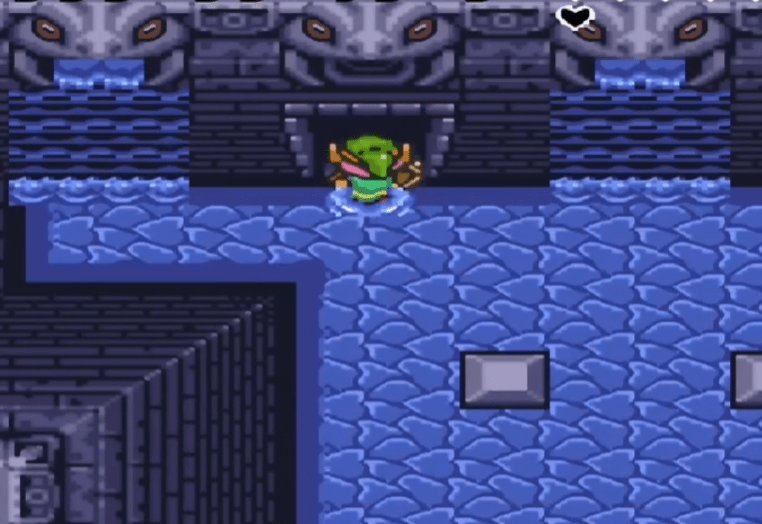
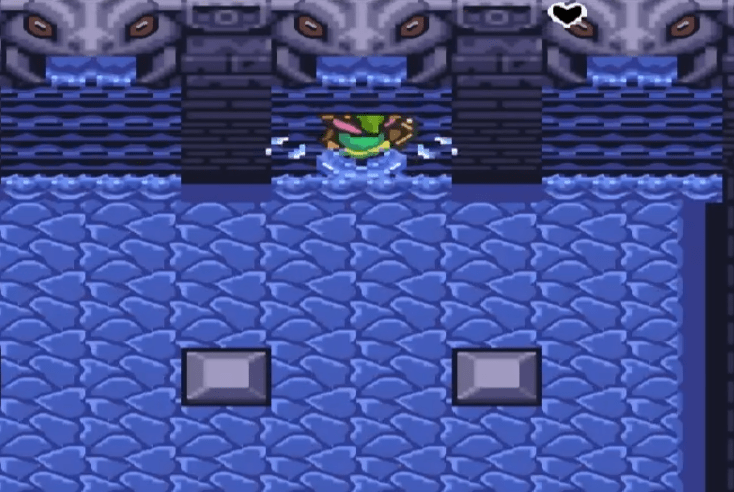
- There’s a handful of fairly frustrating puzzles – my prime example is the water dungeon in the shadow world (it’s the second dungeon). In one of the rooms, Link is seemingly stuck in a dead end. That room is a rectangle and in the upper left corner, there’s a door that connects to a different room. There’s a number of that spew water and that door has a fountain too but it does not spew water. There’s no way of progressing, seemingly. Other than few stones, there are no signs of an apparent puzzle. It took me a while to understand that I needed to look at the map and see that there’s a connecting room that leads to the boss and that the path there was behind a water curtain. Walking through it was all it took. It’s a well-known secret in Zelda that behind waterfalls, there’s often hidden paths, treasures and items – and at that point in the game, we’ve used that already. And we’ve uncovered Agahnim in Link’s first encounter with him behind a curtain as well. Yet, I found that there were too few clues for me to uncover it. I simply didn’t expect it.
World Design
- The world is far busier than I remembered.
- Almost every screen hosts a set of enemies, or something to explore, notice and remember, to come back later.
- There’s a lot of smaller secrets such as caves, waterfalls, NPCs to talk to, paths to go somewhere an item could be hidden – most screens have hints or an actual secret or item
- This design clearly teaches you to look at the pointers on screen, and the environment that Link is traveling in.
- Hints could be subtle, like a small arrow of grass, pointing to a spot in the riverbank to jump into the water – incidentally next to a bridge that opens up a dialog with an NPC offering another bottle to you. Obviously, the classic “cracks in the wall” are all over the place – surprisingly often – that make it a general game mechanic that one needs to look out for in every new screen.
Master Sword
- I remembered the whole part differently. In my recollection, getting the master sword was more difficult. I thought there was a labyrinth that one had to solve before getting to the place the master sword rested.
- Today, it feels less complicated – as soon as you have the three medallions, a few turns and screen changes and you’re there.
- Getting the master sword is also embedded in the linear story, after finding the three medallions and fighting Aghanim. It’s embedded in the story clearly in a specific place for progression – I remembered this as a semi-optional.
- I also didn’t remember that you could improve the master sword twice over – once through the two smiths, once you reunited them, and another time through the fairy that you unlock with the gigantic bomb.
Replayability
- The game still feels very modern and , rightfully, is still the golden standard for “Zelda-likes”.
- The controls are very precise still, playing it both on a SNES mini and the original SNES with the original cartridge.
- The game is still challenging, but if you start buffing early on and take breaks in-between dungeons to explore the world to find extra items, heart containers early on, you are better equipped for more challenges passages, that tip the difficulty in your favor. While many of these items are hidden and optional, if you’re not a pro gamer, you’re more likely to need them.
- Through the constant discovery of items, gems and things to explore everywhere, these rewards motivate to move along.
- For modern players, casual players that want to spend some 10-15 minutes waiting for their train or short before bed, the save/load mechanic isn’t necessarily helpful. Unless you want to stop playing in the middle of the dungeon, the game is built for 45-90 minute game sessions. This opinion is mostly tied to how long dungeons take to master, if you want to solve them in one go. You can certainly split this game down into smaller chunks, working in exploration sessions, but the game wasn’t built to support that very well (again, it comes from a different time and place).
It’s still a masterpiece – and I can still recommend it, in case you haven’t played it at all, or if it’s been more than 10 years since you last played it. I re-learned a lot about this game.


