SimCity is a fascinating game. Fascinating what it stands for, what it delivered and what doors opened for later games to go through.
Released 1989 on Amiga and Macintosh, SimCity is a city building and management simulation built by Maxis. It was ported to numerous platforms, including DOS, Windows, SNES, PC-98, FM-Towns and OS/2.
The development of SimCity and its history is well-documented and lots of details (e.g. LGR: SimCity 30 Years Later: A Retrospective or the book: Building SimCity which also goes into the early days of computer-assisted simulations). Will Wright just finished his game, Raid on Bungeling Bay, enjoying its success. It’s a top-down shooter game, in which you steer a helicopter across a landscape, finding various targets to eliminate and bomb. As part of the development process, Wright developed a world editor, WEdit, that allows for tile-based placing of buildings, trees, land and sea. Legend has it that Wright enjoyed “playing” with the editor more than the actual game, so he spent lots of time experimenting with it, eventually wondering whether someone else might enjoy building landscapes and cities. His interest for systems and computer-assisted simulation of processes made it so, that he started to develop an editor-based city building game. And so he built a “City Planner” game, that went to be called “Micropolis” under Maxis with his co-founder Braun, to “SimCity” as the released game.
Will Wright built a city in a box – a game that allows for building a city, that requires careful balancing of resources, residential, industrial and commercial zones, infrastructure for people and business to thrive, and careful consideration of what is placed where – as under the hood, the game is a complex, multi-layered conglomerate of multiple individual systems that influence one another. Need money and raise taxes too much? No one immigrates and industry is stuck with too few workers; place to few policy stations? Crime will rise and people move away. Build your energy strategy on coal? You’re polluting the environment, bringing the land value down. Want to speed up growth of industrial zones? Build an airport and a port – so export increases and accelerates.
What’s unique for the time: Sim City does not have set goals to achieve. Unlike shooters, platformers, or any other game on the market, it is not built with an end goal in mind. Driven by Wright’s curiosity and love for building and experiencing the system’s dynamics on change, the game does not have a classic end state. This is what Broderbund, the potential publisher for the game, threw off. They kept asking Wright, when the game would be finished and when the winning conditions were defined and set. Games in the 80s always had a winning state and winning conditions – and often, you competed with yourself, with the computer, or with someone next to you.
There’s also ways to “rebuild” your city: should you ever need to make room for new buildings, there’s the buldozer feature to destroy streets, buildings and other infrastructure. For a more extreme audience, Wright has an extra “Desaster” menu built into the game, that will launch a desaster into your city – floods, earthquakes, hurricanes, nuclear catastrophes, and gigantic lizard-like monsters. Turns out – destroying and upsetting the system and rebuilding it gives a weird pleasure to aspiring mayors and city builders – and crowns city builder pros to city builder masters.
For me, SimCity stands out because:
- It exists because a crafty game designer found joy and inspiration in what started as a tool – and pushed for it, even if the first publishers said “no.”
- It defines a new genre – “Simulations”, and pushed the doors open for so many other, fantastic games that followed after.
- It combines the very cogs-wheels heavy systems design discipline nicely to a nice, easy, digestible computer game for kids and adults alike.
- While not perfect, it succeeds in implementing a very complex set of systems into a nice game – hiding the complexities from the player. At the same time, it succeeds transporting how all systems and city builder decisions tie together – and what influences what. Including letting the player extrapolate more connections and systems that may not exist. Players attribute changes and reactions from the city to the underlying sophisticated system, but there may not be a system that connects their last actions to anything meaningful.
- It succeeds, despite the fact that there’s no imminent goal, no greater set of points or approval rate to achieve. It succeeds without competition or the virtual challenge of a computer opponent.
And while playing and researching, I uncovered a few “fun facts”, that make the game even more lovable:
- Portions of the source code for the C64 port were lost – apparently Wright used to work off of random floppies and might have overwritten them. There’s a rumor that the C64 version had to be manually byte code edited to be named “Sim City”, so it could be shipped.
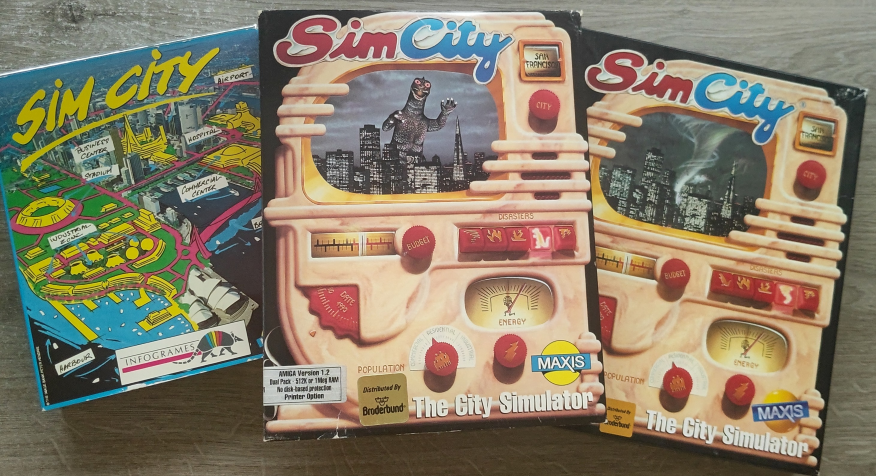
- The box art in the US is different from the box art in Europe. One started as a radio or TV that had various dials and knobs. On the screen, there’s an angry Godzilla displayed, revenging the city. After “complaints” from Toto, who own Godzilla, the box art had to be displayed to show a hurricane.
- In the SNES version of Sim City – what is a lizard-type monster on the other platforms, is a Koopa on SNES.
- There was a “mayor popularity” rating planned that still is in the UI, but does not have meaning or wiring into the game – it simply got dropped. Possibly because of memory constraints.
- Don’t worry too much about your energy plants. Connect the first one to the grid, the rest of them you build don’t have to be connected. They just work. Wirelessly.
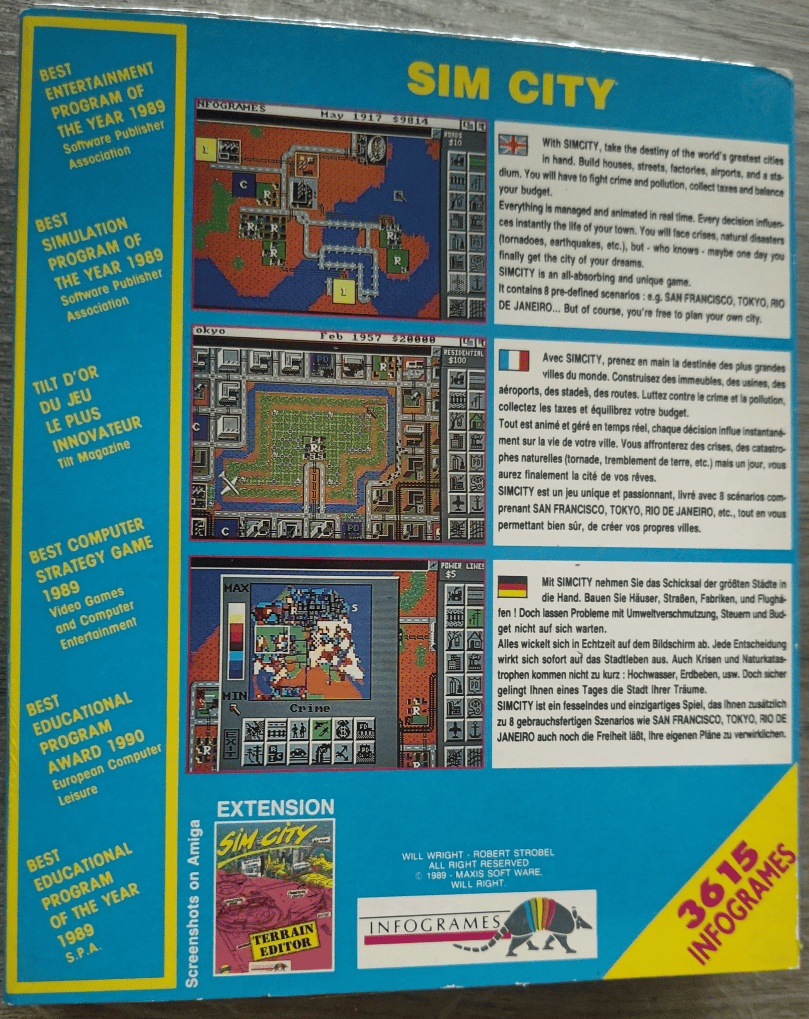
- The European box art is showing a comic-style picture of the city of Sydney.