
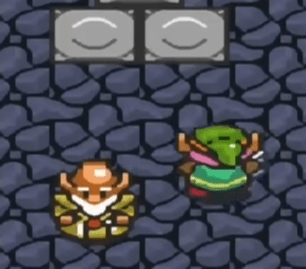
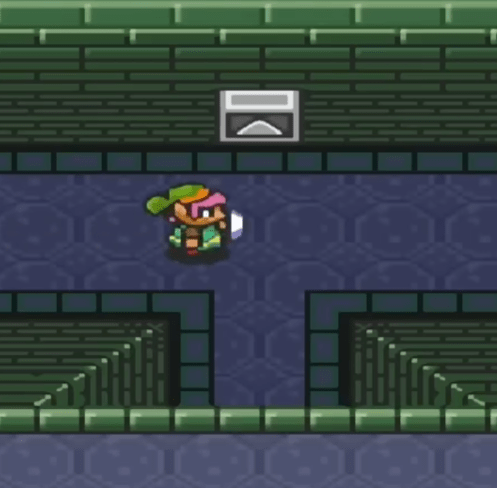
One of the things that I’ve recognized in my latest playthrough of Zelda: A Link to the Past is, that it also has a built-in help system. You might remember that particular design choice not as a hint system, but as the eldest from Kakariko, that you meet early in the game, and then later on, optionally meet in so-called telepathy tiles in a number of dungeons. You can approach these telepathy tiles and activate them – they are embedded in some walls and you would then be able to speak to Sahasrahla and he would give you hints on how you progress and how you can move along.
In one of the more pressing or more important interactions with Sahasrala in these telepathy tiles is short before you meet Agahnim for the first time. Because Sahasrahla is giving you the hint that you can’t defeat Agahnim by using your master sword and beating him with it. He is still resistant. You need to try and use the Master Sword to reflect Agahnim’s energy that he directs at you – that is an important hint because by that point in time you have freshly acquired the Master Sword, have made your way to back to the palace, but you might not immediately realize that you can’t beat Agahnim with direct hits. It’s a new game mechanic that is given you through the hints, that otherwise cause a few minutes of frustration, if you’re missing the hint and you try it on your own.
The way they introduced the system is quite clever in the sense that Sahasrahla is first referenced in Kakariko as being a person that is outside of the village in a hut near the East Palace. You travel there and you meet Sahasrahla for the first time – also making it the one of two times you meet him personally. When you talk to him, he’ll give you the rest of your quests, which is finding the three medallions plus the master sword to then go and free the world from #agahnim. Sahasrahla is introduced and anchored as an important person early on in the game – you can trust him, as he sends you on the rest of your journey. Conveniently, the first palace you go to and solve is right next to him; which makes it almost such that he waited for you to accompany you part of the journey to the first palace door. After the first palace, you meet him the second and last time, when he gives you the running shoes as a reward for the first medallion you found. Subsequent visits are optional – but not necessary. And they do not warrant more contextual hints for the following dungeons you’re going to.
The way this is designed, it embeds nicely into the story and the gameplay. The option to speak with Sahasrahla is there if you need it, but it’s not in your face. Even if you approach these tiles and you invoke the telepathy to Sahasrahla, it’s not a lot of back and forth dialogue to go through, nor does the game force you to choose text options for replies – it’s designed as a one-way communication from Sahasrahla to you, a few lines of text to quickly read, and then go on. I didn’t feel that it interrupted immersion too much, because the information that you get is very short and very pointed to some puzzle or some imminent next progression that you need to go through – or a challenge to beat.
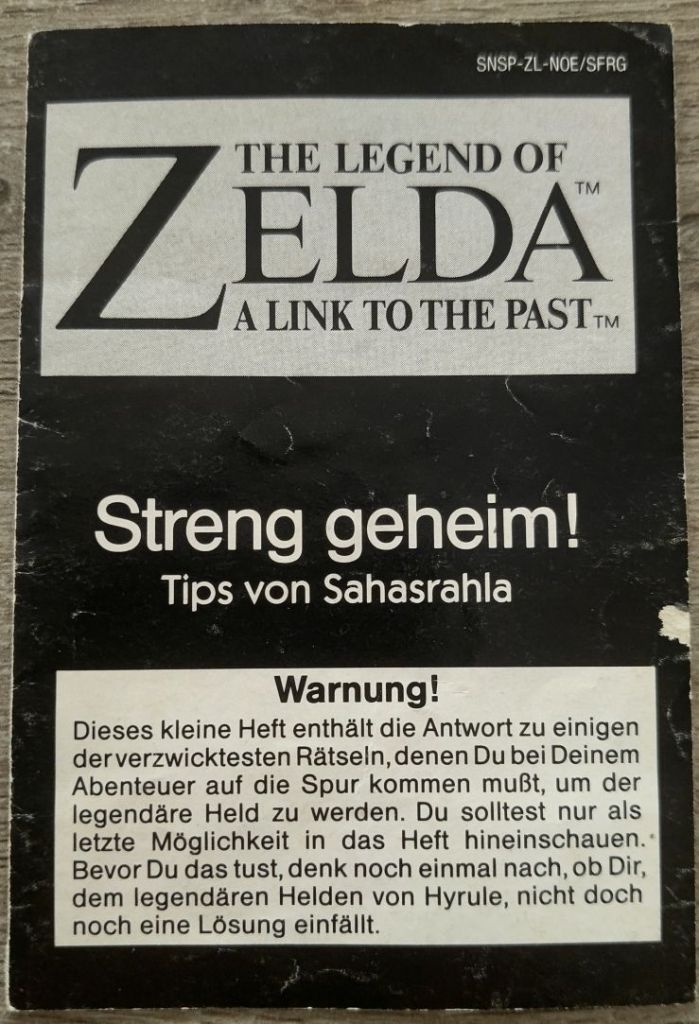
Specifically for the European release of A Link to the Past, there was a physical booklet in the box that you would be able to open, that contained hints and solutions to puzzles that Nintendo found too complicated and possibly too juicy for European players. The label on this little black and white booklet on the very front in large letters is “top secret” (my German edition says: “Streng geheim”) and It’s sealed, so you can’t accidentally open it. You have to deliberately open it, if you need additional clues.
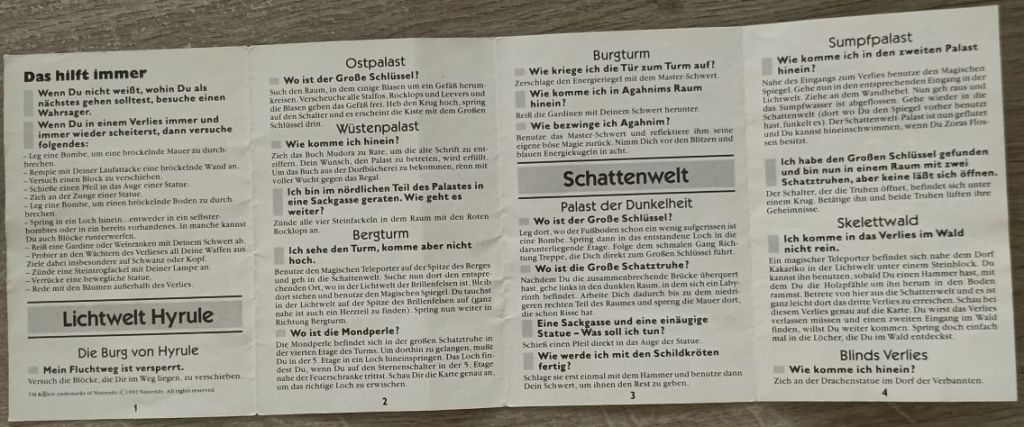
The idea back then was, that European players might not necessarily have a lot of experience with RPGs and action adventure games, and that puzzle solving and lots of narrative in a game isn’t what the Western players are used to and might not have enough patience to always go through. As a result, they might miss clues and then they might get frustrated because they don’t know what to do or how to progress in the game. Therefore, Nintendo went out of their way, and specifically packed an additional hint book for the European release, into the box.
Next to Sahasrahla, there is another game mechanic that qualifies as an in-game help system. That is the fortunetellers that you can meet in both the light world (two of them) as well as the dark world (one). They have a static location you can always visit. For a small amount of rupees, they will give you cryptic advice as to what to do next or a hint on where to go next. They do not give you a straight answer – you need to read between the lines, as always, when you visit a fortuneteller. At the end of the interaction they refill your hearts as well, which makes the investment of 10-30 rupees a little more worthwhile. Like Sahasrahla after the initial meet up and after the first dungeon, the fortunetellers are completely optional – you don’t have to visit them and you can fully ignore them as they don’t have another purpose in the game other than giving you advice if you pay them.
There were hint systems before in the earlier two Zelda games, but they weren’t a specific person that you relied on. You would always meet random cavemen or townspeople and you would meet them throughout the game. You would find them in strange places and it would be different people every time. This kind of in-game help feels entirely different, as you didn’t expect them or look for them, you ran into them coincidentally more often than not. Sahasrahla feels a lot more like a deliberate attempt to establish a trusted person that goes along with you on this journey that wants to see you through all of the battles until the end.
Compared to the later companions and “hint systems” in the Zelda franchise, for example, Navi, Fi, or Purah in the latest Zeldas, Sahasrahla was still very laid back and very optional, didn’t break immersion too much and let the player very much go along on their journey. He stayed in the background and as an optional character.
Navi, Fi and Purah clearly are more embedded in the story and more intrusive in the sense that it would come up as a UI item and … “nag” you when there’s something urgent they believe they want to relay to you. They would stop the game and give you dialogue and pointers and additional information if you want it or not; clearly changing the dynamic of how some of the in-game help and some of the game flow and the immersion was designed later on. We could argue that Nintendo didn’t see them as “in-game” help but more as companions that are closer to Link and therefore more central to the story, the game experience and therefore, rightfully “interrupting” gameplay, positioning them as a central resource and mechanic in the game.


